A couple of weeks after we launched the new Stroke Aotearoa New Zealand website—a project I was proud to work on during my time at Springload—I found myself staring at a set of analytics that made absolutely no sense.
One specific page, the story of a retired police officer from the Far North who had survived a stroke—was suddenly blowing up. It’s an honest, hopeful story, but it’s not exactly the kind of thing you expect to go viral in the middle of America. Yet, there it was: thousands of people from Ohio were flooding onto a local NZ website to read about a man from the other side of the world.
At first, we were just baffled. Then we looked at the name of the survivor: Dave Matthews.
Someone on the team, only half-joking, said: “What if they think it’s that Dave Matthews?”
I did a quick search for “Did Dave Matthews have a stroke?” and there it was—a confident, AI-generated overview saying "Yes." It featured a photo of the Grammy-winning musician, but the summary underneath was lifted straight from our website, telling the story of a completely different Dave here in Aotearoa.
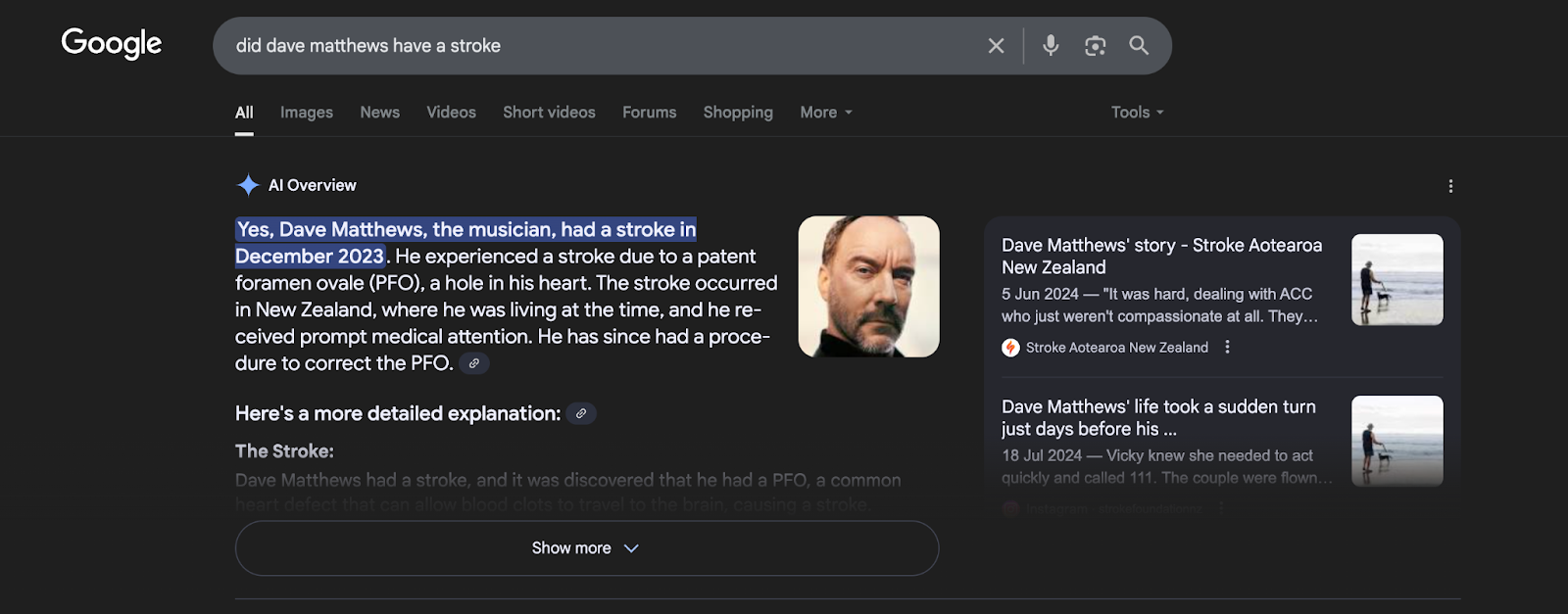
It got stranger. A US news site, Cleveland.com, had repeated the claim. They didn’t mention Stroke Aotearoa; they just merged the AI summary into an article as if it were a confirmed fact:
“Given that Matthews had a heart attack and two strokes in his recent history, you would forgive him for a bit of navel-gazing.”
– Cleveland.com, before the correction
It was a total "you have to see it to believe it" moment. A survivor story from a small New Zealand not for profit had become a global rumor about a rock star. It wasn't one glaring human error but a chain of automated decisions that seemed completely "reasonable" to a machine.
We got a brief spike in traffic, sure, but we also got a front-row seat to a much bigger question: In a world where machines are doing the summarising, what do visibility and accuracy really mean?
How did AI stitch two stories into one?
To understand how a stroke survivor in Aotearoa became a global rock star rumour, we have to look at how AI actually "thinks." Most AI overviews are powered by a process called Retrieval-Augmented Generation, or RAG.
It sounds complex, but it basically boils down to the AI doing three things:
1. Retrieval: finding what looks useful
When you search for “Did Dave Matthews have a stroke?”, the AI scans a giant index of websites looking for any content that seems relevant. It isn't just matching exact keywords; it uses a concept called embeddings to compare the "meaning" of pages rather than just relying on a keyword match So even if a page doesn’t say Grammy winner or US musician, it might still be pulled in if the AI thinks it’s about the same general idea.
2. Augmentation: pulling snippets together
Once it finds a few promising pages, the AI extracts small pieces like a sentence from our Stroke Aotearoa website, a heading from a news article, or an image from another site. This is the “augmentation” step, where the AI gathers the data points it needs for an answer.
3. Generation: writing something new
Now comes the generation step where the AI gets to work writing a new summary. The language model (like Gemini) takes those fragments and starts writing a new paragraph. It's been trained on massive amounts of data to mimic how we talk. It knows how a clear and fluent answer should sound, but it's fundamentally a prediction engine, not a fact-checker. This means it can get it wrong—yet sound really convincing while doing so.
So what likely happened in the Dave Matthews mix-up?
In our "Dave Matthews Gate," the AI likely found our genuine stroke story alongside pages mentioning the US musician of a similar age. Because the names and ages matched, it assumed they were the same person. It then combined snippets from both to generate a fluent, confident, and utterly mistaken answer. To make matters worse, if people saw that summary and didn't bother clicking through, the system took that as a sign of success. This simply reinforced the error for future searches.
AI summaries are not all bad
Look, it's not all doom and gloom. A lot of the time, AI is brilliant. Ask a straightforward question like "how to fix a leaky tap" or "best time to plant kowhai" and you get an instant, perfect answer. It’s fast and convenient– You don't need to click, skim, or piece things together. That convenience is exactly what makes it powerful, and disruptive.
People trust what they see, and often don’t click further. When AI Overviews appear at the top of a Google search, visits to websites can drop by around 35%. The overview summary becomes the destination. And the original content (where the information came from) is often left behind.
This forces a shift in strategy: from chasing the click to owning the fact.
If someone gets what they need—your advice, your voice, your facts, directly from the search box, your content is still doing its job. You can't control what bits of your content an AI will lift or combine. But you can make your words clear and strong enough to stand alone, even if they're separated from their usual context.
Your content's new compass: How to thrive in the AI web
So, what does all this mean for us, the people making content? The golden rules of good content and SEO haven't vanished, but they're now operating in a wild new world. Here’s how to give your words the best chance to stay clear, useful, and true:
Start with a clear message
AI models are highly adept at extracting just one sentence to use as an instant answer. This is often the very first sentence on the page. Because of this, opening paragraphs need to be perfect, standalone summaries. They should make sense even if they are ripped away from the rest of the page.
It also helps to repeat your main point in headings, captions, and subheadings. This isn't just for the reader. It increases the "salience" of the message for AI, making it more likely the machine understands what the most important fact on the page is.
Use plain language and be specific to a fault
Machines do not do nuance. They predict meaning based on patterns rather than understanding writing like a person does. If your writing is vague, it is easier for the model to get it wrong.
Use natural, straightforward language that reflects how people actually talk about a topic. Be especially careful with names or acronyms. If you don't clearly state who you are talking about, the model might guess. Add clarifiers, such as "Dave Matthews, a 58-year-old New Zealand stroke survivor," so the context travels with the facts even if a sentence gets lifted.
Structure your content clearly and ensure it’s crawlable
A clear structure of headings, bullet points, and summaries helps real people scan your site. For AI, these are signposts. If your page is a dense, unstructured wall of text, the AI is more likely to miss the point or choose a fragment that doesn't reflect what you meant.
This is especially important on the code level. If your key messages are buried in images, PDFs, or complex JavaScript, they effectively don't exist for AI. For example:
- Use <h1>, <h2>, etc. for headings, not just bold <p> tags
- Write meaningful alt attributes for images, especially those containing stats, illustrations, or diagrams
- Use <table>, <blockquote>, <article>, and other semantic tags where appropriate
Link clearly, explain your facts, and show your credibility
Internal links help readers navigate and signal "topical authority" to traditional search engines. For generative AI, they help models infer what content is related. Use descriptive link text—like “stroke recovery resources” instead of “click here”—to tell both people and machines where they’re going.
AI tools also prioritise signals of credibility, often referred to as E-E-A-T.
- Experience & Expertise: Include author bios that show you know what you're talking about.
- Authoritativeness: Link to expert sources and reputable data.
- Trustworthiness: Include visible "last updated" dates. If a page doesn’t explicitly show that it is fresh and verified, an AI might bypass it for something that looks more recent, even if your information is more accurate.
Bonus: add structured metadata using schema.org
Schema.org is a shared standard that helps machines understand what your content is, not just what it says. Adding this invisible layer to your HTML gives AI tools the confidence they need to pull the right details into summaries, especially for definitions, dates, and key facts.
So, where to from here?
We’re finally living out the dreams Ask Jeeves promised decades ago: ask a question, get an answer. People now get what they need straight from the search box before they ever reach your site. That is a win for convenience, but it also means your message needs to be clearer, stronger, and more resilient than ever.
You don’t need to overhaul your entire site overnight. It’s about starting with the pages that matter most and applying these principles to ensure they are built to be understood by both people and machines. Whether that’s tightening your opening paragraphs or cleaning up your site's underlying code, the goal is the same: stay visible and stay true.
Be specific, be structured, and be unmistakably you. Stick to that, and you’ll be fine.
Even if you’re (not) Dave Matthews.
If you did end up here because of that Dave Matthews mix-up, or you just enjoyed the story, please consider supporting Stroke Aotearoa New Zealand. They provide vital services for stroke survivors and work to prevent strokes across New Zealand.
Credits & Context:
Thumbnail photo on listing page: "Dave Matthews 1" by Moses Namkung / CC BY 2.0
This project was delivered during my time at Springload for Stroke Aotearoa New Zealand.